Wednesday, January 9, 2013

Connecting with Nature in 2013


Students enjoyed an outdoor trail walk on ESA Day with
Connecting People with Nature.
Credit: Nick Jeremiah/NOAA
As you may know, the U.S. Fish & Wildlife Connecting People with Nature team has one overarching goal – To connect people with nature. As a team, we are nature enthusiasts who enjoy talking to people, being outside, and encouraging others to join us. Digging (pun intended) deeper into that goal, we especially aim to reach youth, and other groups who don’t spend much time outside. What you may not be as aware of is how we make this goal a reality from behind the scenes.

Each year, the Connecting People with Nature Team receives funding from the National Conservation Training Center in Washington, D.C. to help connect people with nature. We ask employees from around the Pacific Region (Hawaii, Idaho, Oregon and Washington) to apply for a portion of this grant money to fund projects that help educate, engage and employ different groups in nature and the conservation of nature. At the end of our fiscal year (right around the months of October/November) USFWS groups from around the region submit project proposals, and by the beginning of the new year, funds are distributed and the real "connecting" begins!

Salmon in the Classroom, a project supported by a Connecting People
with Nature grant.
Credit: USFWS
When it comes to being selected to receive these funds – a bit of creativity, a helping hand from partners and a lot of hard work are what it takes! We want to make sure our dollars go as far as possible in the most efficient and successful way. Therefore a thorough review process assures that projects that receive funding fulfill our most important goals: 1. Reaching youth and underserved audiences, 2. Supporting conservation and education, 3. Providing internships, volunteer opportunities and employment 4. Working with partners and 5. Developing successful and measurable results. Now, if you aren’t very familiar with grant proposals and funding and all that scientific and economic jargon, I will share with you five of the projects that were funded for 2013 from around our region!

Hakalau Forest NWR
Credit: David Patte/USFWS
Hakalau National Wildlife Refuge (NWR): Youth Climate Change/Forest Phenology Project with University of Hawaii - Workshops for Students and Teachers
  •  Project is led by Refuge Manager, Jim Kraus.
  • Focus is on bringing Native Hawaiian and Pacific Island youth and low income families to the remote Hakalau Forest NWR on the island of Hawaii.
  • Funding for the project will help the Refuge to employ two training workshops for local high school biology teachers empowering them to carry on the curriculum and trips to the refuge for years to come.
  • Working with partners including local schools, USDA Forest Service, USGS and more, this project will connect local youth with their species, ecosystems and habitats in their natural communities.

Bird watching with Team Naturaleza at Leavenworth Bird Festival.
Credit: El Mundo Communication
"Team Naturaleza" Citizen Science Program - Education Program Coordination
  • Team Naturaleza is a group in Leavenworth, Washington dedicated to connecting the Latino community with science and nature.
  • This bilingual program will employ a trusted Latino Community Liason to connect fellow community members with nature through cultural traditions.
  • Team Naturaleza is comprised of a creative group of nature lovers who will utilize activities like nature walks, arts, birding and citizen science projects to engage and educate the local Latino community.

Students spending the day spawning at Little White Salmon NFH
Credit: Little White Salmon NFH/USFWS
Columbia Gorge National Fish Hatchery (NFH) Summer Youth Employment Program
  • This project is led by Cheri Anderson, a member of our CPWN Team who works out of the Columbia River Gorge National Fish Hatchery Complex.
  • The project's goal is to provide work experience to youth between the ages of 14 and 18 in Skamania County, Washington working with USFWS employees at the fish hatchery.
  • Partnering with the Stevenson Carson School District’s Forest Youth Success program, this summer project will help educate diverse groups of local youth on fish habitat and conservation while providing them hands-on experience in ecology, biology, hydrology and so much more.

Photo of a hermit crab, called dukduk on Guam. This photo was taken
by 11-year-old Faith, as part of a photo contest. One of the many
examples of engagement we will see from this project.
Credit: Guam NWR/USFWS
Guam National Wildlife Refuge (NWR) Threatened & Endangered Species Program Outreach – Intern
  • This year, the Guam NWR celebrates its 20th year, and they will be celebrating by sharing the spirit of conservation.
  • This project will employ a summer outreach intern to help plan, promote and carry out a number of events celebrating the Refuge's 20 years of conservation.
  • The student intern will travel around to local k-12 schools and colleges offering free presentations on threatened & endangered species, conservation and biology while showcasing 20 years of great conservation efforts at Guam NWR.
  • This event will also engage the community through creative activities such as a native species art contest.

Keeping an "eye on nature" at Nisqually National Wildlife Refuge
Credit: Ingrid Barrentine/Joint Base Lewis-McChord
"Eye on Nature" Youth STEM Studies - Teacher and Student training/field trips
  • "Eye on Nature" is a full-circle, four-part program led by Sheila McCartan, Education Coordinator at Nisqually National Wildlife Refuge.
  • The goal of this program is to educate local and tribal students (grades 3-10) and teachers about the mission of USFWS Refuges and the significance of Nisqually NWR.
  • The project will first train students on observational skills and conservation strategies. After this training, field trips to the refuge will be provided where teachers and students will test out and better the skills they learned in the classroom. After returning, the teachers and students will participate in post-field trip lessons which will include analysis of data gathered during their trip.
  • This project will help to give students hands on experience in the field of conservation, and bring these exciting activities back to their classrooms.

Wednesday, December 26, 2012

Nature in the Holidays


From the U.S. Fish & Wildlife Pacific Region Connecting People with Nature Team - We wish the happiest of holidays to all of our readers. Enjoy spending time with friends, family, and even strangers out in nature! We wanted to share some great stories, photos and videos related to nature and the holidays! Enjoy!


Friday, December 14, 2012

A True Steward of Conservation

"The environment has so much more to offer us than you know: it nurtures us, it calms us, it entertains us, it does so many things for us, and as a consequence, we have to make sure that we can keep it healthy so we and every other living organism can prosper as well." – Kristi Fukunaga

Kristi Fukunaga in Idaho during her educational travels with USFWS
Credit: USFWS
When you think about the job of the USFWS' Connecting People with Nature Team (CPWN), what you might not think about is that we don't stop our efforts at simply encouraging people to get outside. A large portion of our program helps fund projects that aid groups, especially youth, to connect with nature in ways they wouldn't ordinarily have the opportunity to do on their own.

Shaping the future
When working with youth audiences, our main goal is to help facilitate a lifelong love for nature that they will carry out into their own world, to share with their friends, families and community. Often, we come across a group who go above and beyond what we hope for our youth conservationists. Over five years ago, the CPWN Team began working with a group of girls on conservation projects around Oregon, Idaho, Washington and Hawaii. With some initial funding, the girls were able to travel around the region, meeting local conservationists and learning about many of our local species. This past year, this group of three girls took their passion and knowledge out into the field as part of their gold award for the Girl Scouts of Oregon and SW Washington.

Kristi and fellow Girl Scouts at the USFWS Ashland Wildlife
Forensics Lab in Ashland, Oregon.

Credit: USFWS
From the ground, up
Kristi Fukunaga, one of the three girls, focused her project on the effects of plastics on marine life, a topic close to her heart. Kristi explains that she gained her knowledge and love for nature through her travels with ECO-GIG (Ecology: Girls in Green), where she was given the opportunity to work with a number of USFWS biologists in developing ideas. She then created a project from the ground up that would help her local community understand how tossing their plastics could harm local wildlife, and how they could help make a difference.

Kristi in Idaho working with the Bureau of Land Management
tagging feruginous hawk "chicks."

Credit: USFWS
Spreading knowledge
Her project had two main components, the first of which Kristi described as the most nerve racking, but most rewarding. "I created and gave presentations about plastics and their effects on marine life at the Oregon Museum of Science and Industry, Girl Scout Camps, my Buddhist temple, and my high school. Knowing that I got an environmental issue close to my heart exposed to so many people was the highlight of the project," Kristi shared. Kristi wasn’t all talk, either; her next step was action.

Working with her ECO-GIG group at the
Oregon Coastal National Wildlife Refuge

Credit: USFWS
Passing it on
Kristi then planned and organized recycling and compost stations at an annual picnic that welcomed over 500 guests. She helped explain the proper use of the stations and encouraged members at the picnic to continue using these strategies. "We saved about three quarters of the recyclables and 150 pounds of compostables from entering the landfills. I also documented how these recycling stations can be managed so that the community could continue this effort in the future."

In Kristi's future, she wants to attend college to study biology or environmental science and to one day have a job in the conservation field, she says, "would be perfection."

To be continued...
Kristi's story is a great example of how successful exposing children to nature at a young age can be! If you are interested in learning how Kristi's fellow ECO-GIGers put their love for nature to use, stay tuned, the stories of their projects are an upcoming Faces of Nature feature!

Monday, December 10, 2012

Getting to Know Tweets & Tree Frogs

Behind the scenes of nature blogging.
Credit: Meghan Kearney/USFWS
In the wide digital world of the internet you'll find your Tweeters, your Tumblrs, your eBay salesmen, or your gamer. Then, somewhere fewer and farther between, you'll find your tiny niche of nature enthusiast bloggers typing away about how you should get off of your computer and head outside. We are a confusing bunch of people because we almost assuredly wish to be out climbing a mountain with every pressing edit, thesaurus check, and photo upload. We also like to confuse you by asking you to read our blog that will eventually recommend you get off of your computer and head outside… But the truth is, in our defense, we already love nature, and since you are busy reading this, it is our job to win you over.

Christy Peterson with a Gopher Snake
Credit: Cascade Creative Services
Like myself, and all of us here on the U.S. Fish & Wildlife Connecting People with Nature Team, Christy Peterson holds a passion for nature that is too contagious not to share. As a non-fiction children's author, parent, blogger, and nature enthusiast, Christy shares her creativity and passion for nature partially through her online hub Tweets & Tree Frogs (the other portion is the good old fashioned way – out amongst the Earth). Through Tweets & Tree Frogs, Christy hopes to connect with parents, teaching them to love nature and to instill that same passion in their children. As a fellow nature blogger, I wanted to get Christy's take on nature, creativity, and technology. Please enjoy Christy's responses, make a visit to her blog and Facebook page to learn even more, and then, you guessed it: get off of your computer and head outside.

Faces of Nature: Tell us more about your idea of "accessible nature." What advice do you have for those who may not know they can find nature just about anywhere?
Christy: The short version: go outside! It really is just that easy. The longer version: we share the world with an amazing array of life forms. These life forms are amazingly tenacious. Weeds sprout up in sidewalk cracks; moss grows on concrete dividers. Trees shade busy streets and pigeons nest wherever they can. We don't even have to go outside to find nature. No matter how tidy we are, there are plenty of creatures living in our homes. That creeps a few people out though, so I usually don't start out talking about that!

Christy learned to love nature at an early age just like
every child should!
Credit: Bob Tuck
What are some of your favorite urban/inner-city nature activities that kids and families can participate in? 
I love the idea of a scavenger hunt. While it's true that nature is everywhere, cities aren't the most hospitable environments for plants and animals. Finding nature there is a challenge, and kids are always up for a challenge. Things you could put on your list include the grass, moss, trees, and pigeons I mentioned above. You can also include flowers, insects, spiders, house sparrows, though these will be a little more challenging to find. Some cities are lucky enough to have hawk or falcon nests. Just remember, city nature walks have unique potential hazards. Make sure kids have safe parameters so everyone has a good time.

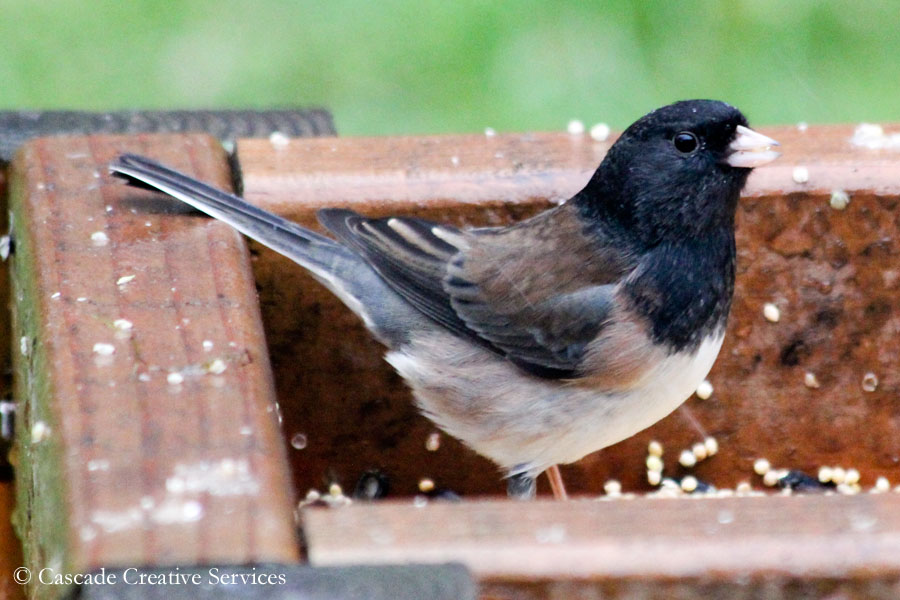
A Dark-eyed Junco - featured on Tweets & Tree Frogs "Bird of the Week"
section.

Credit: Christy Peterson/Cascade Creative Services
You encourage combining nature and creativity – what are some of the most successful ways you've seen youth get creative in nature?
When I talk about nature and creativity, it's usually in reference to my own work. I think it's hard to be creative when sprinting at the speed of life. Being in nature helps me slow down and clear my head. I think it does the same for kids. I like to be a facilitator for my own kids, rather than presiding over structured activities. By facilitator, I mean that I try to provide a seed of an idea or a few raw materials and then let their imaginations take over. When my kids were younger, it was fun to watch them make "soup" in an empty cat litter bucket with water, sticks, leaves, mud, and whatever else they could find. My friends and I used to do that when we were little, although we had access to windfall fruit, so our soup was tastier (just kidding!).

A garden spider named "Lucy" by Christy. I've personally
found that naming "scary" critters makes them
seem less scary.

Credit: Christy Peterson/Cascade Creative Services
What kind of experiences have you had working with children and families in efforts to change their ideas about "dangerous" or "scary" creatures and help them to care about nature?
I doubt there are kids reading the Tweets & Tree Frogs blog, so really my work has been educating parents about "scary" creatures. I think parents and teachers can do two things to help kids have an accurate understanding of commonly misunderstood creatures. First, they can educate themselves. What threats do these animals really pose (usually much less than their reputations) and how can we avoid harm? Second, they can try not to pass on their personal biases to their kids. I am a cheerleader for all kinds of maligned creatures, but I really, really do not like parasites (like ticks and lice—ewwww!). They kind of freak me out, but I try not to pass this bias on to my kids.


Christy's son during his first of many encounters
with lizards!

Credit: Christy Peterson/Cascade Creative Services
 Our blog theme is "the faces of nature" because we love seeing the "faces" of those having a brand new experience with nature. Do you have a story to share about witnessing the joy, surprise or excitement of someone's first experience with nature?
I'm attaching a photo that answers this better than words. It is my son's first encounter with a Western Fence Lizard. He had just turned one. He is 10 now, and shares his room with 3 lizards, a snake, and a frog. He wants to study herpetology. Whether he really ends up in that field or not, he has made a connection with "the wild" that will be with him all his life. That's what it's all about.

Given the opinion that technology is taking kids away from nature & being a fellow Facebooker/blogger - What successes have you found through use of your blog and social media pages that have encouraged people to care about nature? 
We humans always like to take things to the extreme, don't we? Technology=bad; nature=good. This is the message I get from some (not all) in the "children and nature" community. Personally, I think technology is a tool. We can use it wisely or not, but it is not inherently bad or good. Technology means I can log nature sightings in the field. I can find out what species of tree I'm standing under. Technology is blowing the world of citizen science wide open—I find this very exciting. Personally, technology has allowed me to connect with people all over the world who care about nature as much as I do. My blog and social media allow me to pass along information I hope will be interesting and helpful to others. Time will tell whether I am reaching new people with my "accessible nature" message or just preaching to the choir!

Thursday, November 29, 2012

Faces of Nature Winter To-Do List


It's that time of year again – the sun has left and we here in the Pacific Northwest are left with a mixture of cold, rainy, slushy and snowy weather. But this is no reason to stop hanging out with nature! We've compiled a list of some of our favorite exciting, creative, adventurous, and fun outdoor winter activities to keep you exhilarated even under gray skies!

Decorate Trees for Birds
A tree decorated with edible treats for birds.
Credit: Debh2u/Flickr Creative Commons

The Fall and Winter seasons bring a number of birds to the Northwest, but sometimes finding food can be harder for birds in the winter. This winter activity is a triple whammy. Start your activity by bird watching. You can visit a National Wildlife Refuge or even view your own backyard to check out what kinds of bird species you can find. Spend some time learning about each one with a friend or family member. Once you're knowledgeable about your local birds, grab some supplies from outside, like pine cones, and gather foods that birds love (peanut butter, fruits, seeds). Choose a tree that you’ve spotted birds in, and start decorating! Use twine to hang peanut butter covered pine cones and fruits from branches. Finally, sit back and watch your neighborhood birds flock in for a sweet treat! Take notes if you see any you recognize!


Yurt Camping
A yurt cabin, great for winter time camping!
Credit: Justin Miller/Flickr Creative Commons
 
Camping is one of the best outdoor activities for all ages and groups, but tent camping in the winter seasons can get quite rainy and chilly in the Northwest. Instead of tents – look into yurt camping! Yurts are circular structures that are somewhat of a mixture between a tent and a cabin. They have been used for centuries and offer an insulated and weather proof shelter! They have become a popular form of camping in the Pacific Northwest. Check below to find information about yurts in your state parks!

Hawaii (you can probably just head to the beach).

Puddle Splashing
Puddle Stomping at Tualatin River NWR
Credit: Tualatin River NWR/USFWS
If it's not snowing here in the winter seasons – it's raining. Heading outdoors only to get soaked is usually no fun, but with the proper gear and planning, getting your boots wet can be a blast. The Tualatin River National Wildlife Refuge (NWR) hosts Puddle Stompers each year during Portland’s rainy season where kids and families can visit the refuge geared up for rain (for more information and dates on this year's events please contact the refuge at 503-625-5944). The refuge provides rain gear for the little ones and they are off to make a splash! Find similar programs in your area or get suited up in your own gear and do some splashing in your own neighborhood.


Snow Animals
A creative way to switch up the ordinary winter snowmen building!
Credit: Ryan Howley/Flickr Creative Commons
If your winter weather is full of snow, try taking that old tradition of snowman building and making it a bit more interesting! Begin by choosing or learning about an interesting animal. Find a photo (or a stuffed animal) of the animal you choose and head outside. Instead of building Frosty, try your hand at building your animal in the snow! Don't forget to also give it eyes, a nose and a mouth in whatever creative way you can think of!

Seasonal Collage
Seasonal photo collage. A great way to be creative in nature
throughout the year!
Credit: Aunt Owwee/Flickr Creative Commons
Begin a year-long photography project that, when finished, will give you a beautiful piece of art to keep for yourself or share with a friend or family member! First, find an outdoor space that you enjoy year-round. Next, gather your artistic tools (camera, pencils paints). Then, head to your chosen location and create your own snapshot of the area at its current stage. Come back again each season to the same location and take a new snapshot. At the end of the year, turn your four snapshots into a beautiful collage of the seasons!

Snowshoeing
Snow shoeing can be a great activity whether out on a trail or in your
own front yard!
Credit: Mel Issa/Flickr Creative Commons
If you love trail hiking, don't let the winter weather get you down. If your favorite trail gets covered in snow this winter, no problem! Many places during the winter will rent out snowshoes and even provide guided trails. Investigate trails near you, you're sure to find one for all different ages and experience levels! Worst case scenario, if you don't want to travel out too far, strap on some snow shoes and take a walk around the block!

If you happen to be in the Leavenworth, Washington area – check out this exciting snowshoeing event at the Leavenworth National Fish Hatchery!


For the Extreme Adventurers
A fire lookout on Granite Mountain Trail, Washington and shot of
one of the great, scenic views that comes with it.
Credit: Ryan Laferty
Did you know that during the winter seasons the U.S. Forest Service rents out their fire lookouts? Many of the lookouts require a snowshoe hike to get to, and require boiling of snow for safe drinking water. If you are looking to really get away and into nature during the winter, and have a big sense of adventure, this may be your perfect winter activity! For more information on fire lookout rentals, locations and safety tips, please visit the Pacific Northwest Forest Service's site.

We hope you get a chance to try at least one of these winter activities! If you have other ideas, please share with us! And if you do get out to try these, let us know how it went!